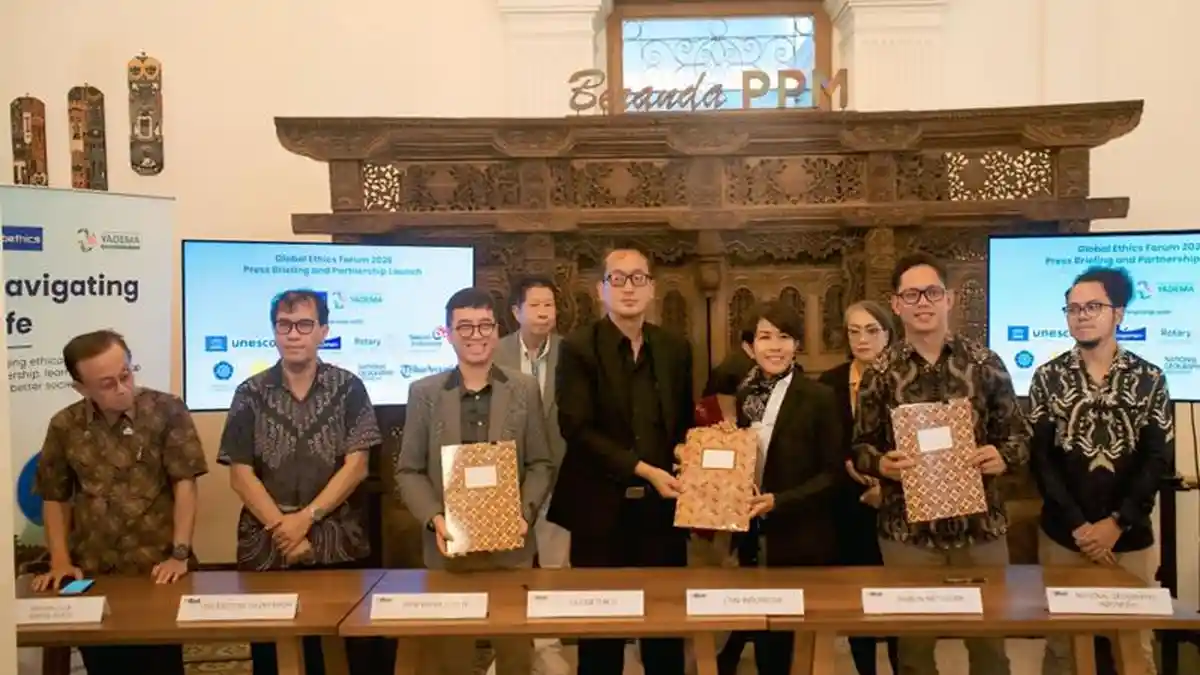
SANUR, BALI — Indonesia has a strategic opportunity to help shape the future of artificial intelligence (AI) governance in Southeast Asia. Rather than serving solely as a market for emerging AI technologies, the country is expected to play a more active role in developing the rules, ethical principles and standards that guide their responsible use.
This was one of the key themes of the Global Ethics Forum (GEF) 2026, held in Indonesia for the first time. Taking place in Sanur, Bali, from 20–22 October 2026, the international forum brought together approximately 200 participants from 18 countries.
Attendees included leaders, academics, business representatives, policymakers and civil society representatives. GEF 2026 was organised by Globethics in partnership with Yayasan Dharma Etika Madani (YADEMA), with support from more than 35 regional and international partners.
“AI development should not be viewed solely through the lens of economic opportunity and technological advancement. Southeast Asia must actively participate in determining how these technologies are developed, regulated, and used responsibly.”
Indonesia’s Opportunity to Shape AI Governance
Dietrich Werner, President of Globethics, emphasised Indonesia’s potential to make a strategic contribution to shaping AI governance, particularly across Southeast Asia.
He noted that AI development should not be viewed solely through the lens of economic opportunity and technological advancement. Its application must also take account of ethical principles, human interests and its wider impact on society.
Southeast Asia, Werner argued, should not simply become a market for AI products and services. The region should also participate in determining how these technologies are developed, regulated and used responsibly.
Werner also highlighted Bali as a relevant setting for bringing diverse perspectives together to discuss global ethics. The Balinese philosophy of Tri Hita Karana, which emphasises harmony between humans and God, among people, and between humanity and the natural environment, was identified as a valuable contribution to international dialogue on technology ethics.
By bringing local wisdom into conversation with global perspectives, GEF 2026 aims to encourage practical, human-centred approaches to AI governance that consider social relationships and long-term sustainability.
AI Governance at the Heart of GEF 2026
AI governance was one of the principal themes of GEF 2026. Artificial intelligence offers significant opportunities, from improving service quality to accelerating knowledge production and helping address complex challenges across multiple sectors.
However, its adoption also raises important questions concerning privacy protection, accountability, fairness, and the distribution of technological benefits and risks.
A global KPMG survey across 47 countries, cited in the original report, found that seven in ten people wanted AI to be regulated. Nevertheless, fewer than half of respondents believed that existing regulations were adequate.
These challenges were explored through three sessions focused on responsible innovation. Discussions covered AI sovereignty, the role of cultural and religious values in technology governance, and practical commitments to encourage more responsible AI use.
Advancing Regional Cooperation on Ethics
GEF 2026 also explored the idea of establishing a regional ethics forum in East Asia and the Pacific or Southeast Asia. The initiative is intended to create further opportunities for dialogue and strengthen cooperation among stakeholders responding to technological developments.
Regional collaboration is important because AI-related challenges extend beyond national borders. Issues such as data protection, algorithmic fairness, developer accountability and the societal impact of technology require dialogue and coordination between countries.
Through initiatives of this kind, Indonesia has an opportunity to contribute more actively to international discussions on technological development that is not only innovative, but also aligned with societal needs and human values.
Business Ethics and Human Wellbeing
Beyond AI governance, GEF 2026 highlighted the importance of ethics in business. Companies are encouraged to look beyond growth and competitiveness, taking account of consumer quality of life, employee wellbeing and the wider social impact of their activities.
Dicky Sofjan, Vice-President of Globethics and founder of YADEMA, emphasised the important role of ethics in addressing global challenges.
He noted that ethical principles can help bridge differences, rebuild trust and reinforce the understanding that human wellbeing, peace and shared prosperity are collective responsibilities.
For international business leaders, these discussions underline the growing importance of responsible leadership, ethical decision-making and sustainable business practices in an increasingly technology-driven world.
Bali as a Destination for Global Dialogue
The hosting of GEF 2026 in Bali demonstrates the island’s potential as a venue for international dialogue that brings together diverse cultural, academic, business and policy perspectives.
While Bali is internationally recognised as a tourism destination, it also has opportunities to strengthen its position as a host for international conferences addressing strategic issues, including ethics, technology, sustainability and human development.
For international meeting planners, Bali offers a setting in which substantive discussions and professional networking can be complemented by distinctive cultural experiences and the island’s established hospitality infrastructure.
The successful delivery of international forums such as GEF 2026 also illustrates the value of bringing together global participants in a destination that encourages cross-cultural exchange and collaboration.
For Indonesia, active participation in forums of this nature represents an opportunity to contribute to the development of global technology governance. The challenge is not simply to ensure that society benefits from AI, but also to ensure that the technology is developed and applied fairly, responsibly and in ways that place people at the centre.
Source: Bali Post, 22 October 2026. (BaliCEB Media Team)